Baishicheng Hydraulic Engineering Team | Technical Content Contributor | Updated: October 8, 2026
Product information in this article reflects what Baishicheng Hydraulic publishes on its website as of October 2026. The process description is general engineering explanation, and individual machine designs differ.
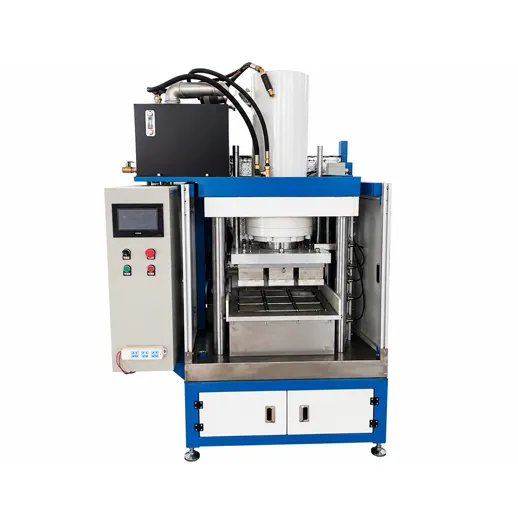
A dry ice block machine turns carbon dioxide snow into a solid block by compressing it, typically with a hydraulic press. Liquid CO2 is expanded into snow, the snow fills a forming chamber, and a hydraulic ram packs it under force until it holds together as one block.
What a dry ice block machine is
Dry ice is solid carbon dioxide. It does not melt into a liquid; it turns directly into gas as it warms, which is why it leaves no wet residue and why it is used for cooling and cold-chain shipping.
A block machine is one way of shaping it. The other common shape is the pellet, made by extrusion. Blocks come from compression: loose CO2 snow goes in, a dense solid comes out. The machine does not make carbon dioxide. It needs a supply of liquid CO2 and turns that supply into a usable solid form.
From liquid CO2 to finished block
Designs vary in automation and layout, but the sequence is broadly the same:
- Liquid CO2 is supplied from a cylinder or storage tank to the machine.
- The liquid is expanded. When the pressure drops, part of the CO2 turns to gas and part becomes fine snow. The gas has to be vented or handled safely.
- The snow collects in a forming chamber. How evenly this chamber fills affects everything that follows.
- A hydraulic ram compresses the snow. The cylinder advances, pressure builds in the chamber, and the loose snow packs into a solid.
- The pressure is held briefly, so the block can set instead of springing back.
- The block is released and ejected from the chamber, ready for handling and storage.
Why a hydraulic press does the forming
Compressing loose snow into a block takes a lot of force applied steadily across the whole stroke, with the ability to control how fast the ram moves and how long it holds. A hydraulic cylinder fits that job, because pressure is adjustable and the force stays available at any point in the stroke. The circuit around it needs a power source, valves for direction and pressure control, and a control system that sequences the stages.
That is the territory Baishicheng works in. The company, founded in 1995 in Jiaozhou, Qingdao, lists custom hydraulic systems, وحدة الطاقة الهيدروليكيةs, and الأسطوانات الهيدروليكية among its core products, alongside dry ice machines.
Block or pellet? A comparison
| البعد |
Dry ice blocks |
Dry ice pellets |
| How they are formed |
Compression in a forming chamber |
Extrusion |
| Shape |
Large single solid |
Small, rice-like pieces |
| Surface area for the same mass |
Low, so they sublimate more slowly |
High, so they sublimate faster |
| Typical use |
Longer cooling and transport, where duration matters |
Applications that need fast contact and small pieces, such as cleaning |
| Handling |
Heavy pieces, often broken down before use |
Poured and portioned easily |
| Machine concept |
Hydraulic press |
Hydraulic extrusion (Baishicheng also publishes a آلة تصنيع حبيبات الثلج الجاف المدمجة) |
The choice follows the application. A buyer who wants long-lasting cold for shipping leans toward blocks; one who needs small pieces that act quickly leans toward pellets. For the pellet side, see our guides on the dry ice pelletizer and the small dry ice machine.
What affects block quality
Three process factors matter in any compression-formed block, whatever the brand of machine:
- Snow consistency and fill. Uneven filling of the chamber can leave soft or crumbly areas.
- Compression and hold time. Too little of either, and the block may fall apart or be less dense than intended.
- Release and handling. A block that is not fully set can chip or break on ejection.
Which settings suit a given machine is a question for its manufacturer. The practical point for a buyer is that block density comes from the process as a whole, not from the press force alone.
Four assumptions that lead buyers astray
- “The machine makes the CO2.” It does not. You need a reliable liquid CO2 supply, and its cost and logistics belong in the project budget.
- “More press force always means a better block.” Force helps only when the snow quality, chamber fill, and hold time are right.
- “Blocks and pellets are interchangeable.” They behave differently as they warm, as the table above shows, and they suit different jobs.
- “A bigger block press is always the safer purchase.” Capacity you do not use still costs space, power, and CO2 supply planning.
Handling and safety basics
Dry ice releases large volumes of CO2 gas as it warms, so storage and production areas need ventilation, and it should not be sealed in an airtight container. It is cold enough to injure skin on contact, so insulated gloves are the normal precaution. Confirm the requirements that apply at your site with your safety officer and with the equipment supplier.
What Baishicheng publishes about its Dry Ice Block Press
| Parameter |
Published by Baishicheng |
| المنتج |
مكابس قوالب الثلج الجاف |
| Forming method |
Hydraulic forming |
| Output form |
Solid dry ice blocks |
| Production capacity |
Not published |
| Block weight range |
Not published |
| Hydraulic pressure |
Not published |
| Motor power |
Not published |
| Machine dimensions |
Not published |
| Price |
Not published; quoted per project |
Compared with block-press product pages that lead with a capacity and press-force table, this is the main drawback: a buyer cannot size the machine from public numbers and has to request a quotation first. The benefit of the project-based route is that the configuration is fitted to your operating requirements instead of a fixed catalogue size.
To get a useful quote, prepare:
- The quantity of blocks you need per hour or per day, and the operating hours
- The block size and weight you want
- Your liquid CO2 supply arrangement
- Available power supply and floor space
- The level of automation you expect
الأسئلة الشائعة
Q: Does a dry ice block machine produce carbon dioxide?
A: No. It converts a supply of liquid CO2 into solid blocks, so the CO2 supply is a separate cost and logistics item.
Q: How is a dry ice block different from dry ice pellets?
A: Blocks are compressed in a forming chamber and have less surface area, so they sublimate more slowly. Pellets are extruded and suit uses that need small pieces.
Q: What capacity does Baishicheng’s Dry Ice Block Press have?
A: Production capacity is not published. It is provided in a project quotation.
Q: How much does a dry ice block press cost?
A: Pricing depends on the project configuration and is quoted individually. No public price range is available.
Q: I already run a pelletizer. Should I add a block press?
A: It depends on what your customers buy. If you receive requests for long-duration cooling or shipping, ask the supplier how the two machines would share your CO2 supply and floor space, and give your current pelletizer’s daily output when you request the quote.

 احصل على عرض أسعار



 8 أكتوبر 2026