Baishicheng Hydraulic Engineering Team | Technical Content Contributor | Updated: October 15, 2026
Product information in this article reflects what Baishicheng Hydraulic publishes on its website as of October 2026. The pump comparison itself is qualitative engineering guidance, not a set of catalogue ratings.
Choose a hydraulic piston pump when the circuit needs high operating pressure, variable flow, or efficiency under changing load. Choose a gear pump when pressure is moderate, the duty is constant, and low cost and simple maintenance matter more. The deciding factors are working pressure, load profile, fluid cleanliness, and maintenance capability.
How the two pumps are built, and why it matters
A gear pump moves oil by carrying it around the housing in the gaps between two meshing gears. Flow is set by the gear size and shaft speed, and in practice that means a fixed displacement.
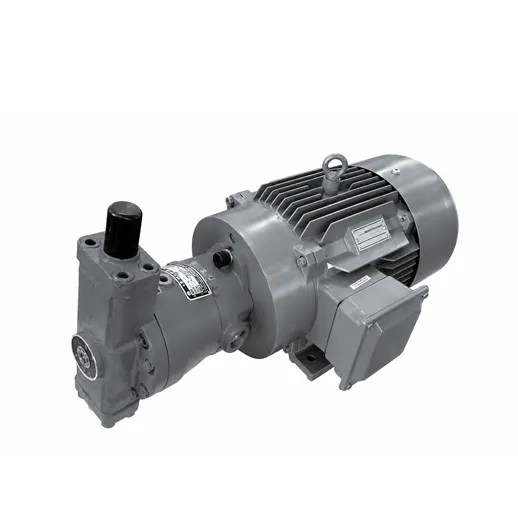
A piston pump uses pistons that reciprocate inside a cylinder block, in axial or radial layouts. In many designs a swashplate angle or an equivalent mechanism changes the piston stroke, so displacement can be adjusted while the motor keeps turning at the same speed. That one difference, fixed versus adjustable displacement, drives most of the practical comparison below.
Piston pump vs gear pump at a glance
| Dimension |
Hydraulic piston pump |
Gear pump |
| Pressure capability |
Chosen when pressure is the limiting factor in the circuit |
Suited to low-to-medium pressure circuits |
| Displacement |
Fixed and variable-displacement versions exist |
Typically fixed displacement |
| Behaviour under changing load |
Variable types can cut flow to match demand, which reduces throttling heat |
Flow stays tied to shaft speed; surplus flow is relieved or throttled and becomes heat |
| Fluid contamination |
Tight internal clearances; needs cleaner oil and finer filtration |
More tolerant of imperfect oil |
| Extra plumbing |
Many designs need a case drain line and careful inlet conditions |
Simple inlet and outlet |
| Purchase cost |
Höher |
Nach unten |
| Servicing |
More parts, usually specialist rebuild |
Simpler construction, fewer wear parts |
| Typical fit |
Presses, high-force and variable-load machines |
Constant-duty, moderate-pressure and auxiliary circuits |
Treat this table as a screening tool. Actual limits vary by model and manufacturer, so the final comparison has to come from the datasheets of the specific pumps you are weighing.
Where a gear pump is the better answer
If the machine runs a constant-speed power pack for clamping, lubrication, or an auxiliary function, and pressure stays moderate, a gear pump does the job at lower purchase cost. It also forgives a missed filter change more readily, and a maintenance crew can usually service it without special tooling.
The costs of choosing a piston pump are specific. The purchase price is higher. Tighter clearances mean a neglected filter can turn into a pump failure rather than just a dirty tank. And if the machine never actually needs high pressure or variable flow, you pay for capability that sits unused.
When does a piston pump earn its higher cost?
Three situations justify it most often: the working pressure is beyond what a gear pump handles comfortably, the load changes a lot during the cycle, or heat is already a problem.
The heat case is easy to overlook. On a press that spends part of each cycle holding pressure, a fixed-flow pump keeps delivering full flow and the surplus dumps over the relief valve as heat. A pressure-compensated variable-displacement piston pump reduces its output to roughly what leakage requires during the hold. Less heat means a smaller cooler and less energy wasted, though the saving depends on how long the machine actually spends holding.
Five checks before you commit
- Write down the real working pressure and the peak pressure, and how many seconds of each cycle the peak lasts. A pump rated for the peak may be oversized for the average.
- Map the duty cycle. Separate time spent moving, holding, and idling. Long holds and idles favor variable displacement.
- Compare your fluid cleanliness with the pump datasheet. Check the filtration level the manufacturer requires against what the machine delivers today.
- Check the plumbing. Confirm inlet (suction) conditions and whether the pump needs a case drain line routed back to the tank.
- Compare lifetime cost, not purchase price. Include energy, cooling, filter changes, and repair.
Four mistakes that cost money
- Choosing on rated pressure alone. A peak rating says little about continuous duty. Ask what pressure the pump is meant to sustain, and for how long.
- Treating a piston pump as a drop-in swap for a gear pump. Mounting, filtration, case drain, and inlet conditions all need checking. Replacing the pump and nothing else is the usual route to an early failure.
- Ignoring cold-start oil viscosity. Thick oil at start-up can starve a piston pump’s inlet. Check the minimum viscosity limit in the datasheet against the coldest condition the machine will see.
- Sizing the motor for the wrong operating point. A variable-displacement pump may idle at low power, but the motor must still cover the highest pressure-times-flow point the pump can reach in your circuit.
What Baishicheng publishes about its High-Pressure Piston Pump and Motor Assembly
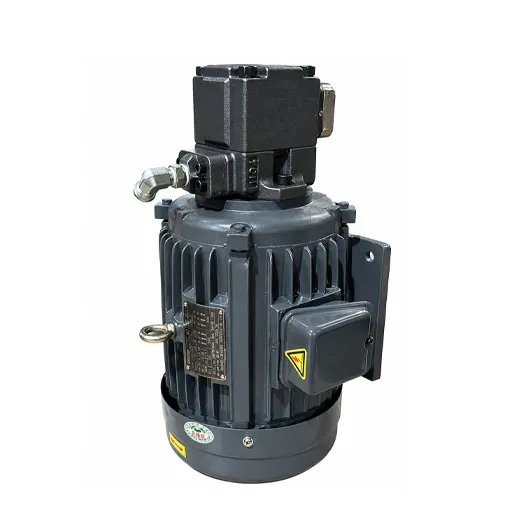
Baishicheng Hydraulic, founded in 1995 and based in Jiaozhou, Qingdao, lists a Hochdruck-Kolbenpumpe mit Motor under its Hydraulic Components category. The published description is short: the assembly integrates a drive motor and a high-pressure piston pump. Customized hydraulic manifold assemblies, solenoid-operated directional valves, hydraulic manifolds, and electric motors are listed in the same category.
What the website does and does not disclose about this assembly:
| Parameter |
Published by Baishicheng |
| Configuration |
Drive motor integrated with a high-pressure piston pump |
| Displacement |
Not published |
| Rated pressure |
Not published for this assembly |
| Flow |
Not published |
| Motor power and voltage |
Not published |
| Price |
Not published; quoted per project |
One point needs care. Baishicheng states capability for ultra-high-pressure systems and cylinders rated up to 120 MPa. That figure describes specially engineered applications, and it should not be read as the rating of this pump assembly or of any other standard component.
That gap is the main drawback for a buyer who wants to compare datasheets before making contact. With no public displacement or pressure figures, the evaluation starts with an inquiry, not a download. To get a useful quote, send:
- Working pressure and peak pressure, with how long each lasts
- Required flow at those pressures
- Duty cycle: moving, holding, and idle time
- Hydraulic fluid type and the filtration level your system holds
- Available power supply and the machine’s mounting space
Compared with catalogue-only pump supply
Compared with buying a pump from a standard catalogue, where you pick from fixed sizes and adapt the circuit around them, Baishicheng’s published approach goes the other way: the website describes engineering around each customer’s operating pressure, flow, load, control, and installation requirements. Its custom workflow covers requirements analysis, design, manufacturing, full-pressure and full-flow testing, and commissioning support.
Häufig gestellte Fragen
Q: Is a piston pump always better than a gear pump?
A: No. A piston pump suits high pressure, variable load, and heat-sensitive circuits. For constant-duty, moderate-pressure work, a gear pump costs less to buy and to repair, and it tolerates imperfect oil better.
Q: Can I replace a gear pump with a piston pump on an existing machine?
A: Not as a straight swap. Check the mounting, the filtration level the pump requires, inlet conditions, and whether a case drain line is needed. Also confirm the motor can cover the pump’s highest pressure-times-flow point.
Q: What pressure rating does Baishicheng’s piston pump and motor assembly have?
A: No pressure rating is published for this assembly. The company states capability up to 120 MPa for designated ultra-high-pressure systems and cylinders, which is not the rating of this component. Request the figure in a project quotation.
Q: How much does the assembly cost?
A: Pricing is project-based and depends on operating pressure, flow, load, control requirements, and configuration. A quotation request is the only route to a price.
Q: What should I prepare before asking for a quote?
A: Working and peak pressure, required flow, duty cycle, fluid type and filtration level, power supply, and mounting constraints. If you already have a gear pump in service, add its model and the problem you want solved, such as heat or pressure limits. A shorter request will still get an answer, but expect follow-up questions.

 Angebot anfordern



 15. Oktober 2026