Baishicheng Hydraulic Engineering Team | Technical Content Contributor | Published: November 3, 2026
A dry ice block machine turns liquid CO2 into solid blocks in two stages. Liquid CO2 is released into a chamber, where the pressure drop flashes part of it into dry ice snow; a hydraulic press then compacts that snow into a dense block inside a mold.
What Is a Dry Ice Block Machine?
A dry ice block machine (also sold as a dry ice block press or block maker) is production equipment that converts liquid carbon dioxide into solid dry ice of a fixed cross-section. The block is the product: it goes into insulated containers for cold-chain shipping, gets cut or shaved for food and laboratory use, or becomes feedstock for other dry ice equipment.
Two machines are often confused with it. A pelletizer also starts from CO2 snow, but it pushes the snow through a die plate to extrude small cylindrical pellets, mainly for dry ice blasting and small-format cooling. A dry ice blasting machine produces no dry ice at all; it consumes pellets. If you are still deciding between block and pellet output, our block press vs pelletizer guide covers that choice in detail. This article stays with the block press and how it actually forms a block.
Why Press Dry Ice Into Blocks?
Dry ice does not melt. At atmospheric pressure it sublimates straight from solid to gas at −78.5 °C (−109.3 °F), a physical property of CO2. Loose snow sublimates fast because of its large surface area, and it is awkward to store, weigh, or ship.
Compressing that snow into a block reduces the exposed surface per kilogram. A dense block lasts longer in a shipping box, stacks predictably, and can be sized to the container it is going into. That is the whole economic case for the press stage.
How a Dry Ice Block Machine Works, Step by Step
The sequence below is the general working principle shared by hydraulic block presses. Cycle times, pressures and block dimensions vary by machine design and are not standard across suppliers.
- Supply liquid CO2. The machine is connected to a liquid CO2 source, usually an insulated bulk storage tank. Supply pressure and temperature need to stay within the machine’s stated window; a supply that drifts out of range produces inconsistent snow.
- Inject into the forming chamber. A valve opens and liquid CO2 enters the forming chamber, which is at much lower pressure than the supply line.
- Flash to snow. Once the pressure falls below CO2’s triple point, it cannot remain liquid. Part of it solidifies into fine dry ice snow and the rest flashes into CO2 gas. That gas is vented, or routed to a recovery system if the plant has one. You can verify this step by watching the chamber fill: snow should build evenly across the mold area.
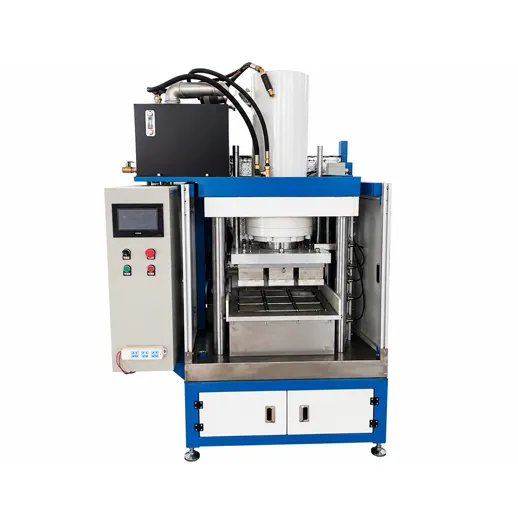
- Compact the snow. A hydraulic cylinder drives a platen or ram into the chamber and compresses the snow against the mold. The press typically holds force for a short dwell so the snow bonds into one solid piece rather than a layered, crumbly block.
- Release and eject. The ram retracts, pressure is released, and the finished block is pushed out of the mold. A completed block should hold its edges when handled with insulated gloves.
- Handle and store. Blocks go directly into insulated storage containers. Some lines cut blocks to length on discharge or feed them into a shaver or pelletizer downstream.
Where the hydraulic system does the work
Steps 2 through 5 are a hydraulic motion problem. A pump and motor build pressure, directional valves sequence the cylinder (advance, hold, retract, eject), and a controller, often a PLC with a touchscreen, runs the timing. The force profile matters as much as the peak force. A press that reaches full force too quickly can trap gas pockets in the block, while one that releases too early leaves a weak core. This is why the hydraulic circuit design, not just the cylinder size, determines whether blocks come out consistent shift after shift.
What Controls Block Quality
Block density and strength come down to a handful of variables, and most of them interact:
- Snow fill consistency. Uneven snow distribution produces a block that is dense on one side and soft on the other, regardless of press force.
- Press force relative to mold area. Force spread across a larger mold produces lower pressure on the snow. Ask for the effective pressure at the mold face, not only the cylinder rating.
- Dwell time. Too short and the block can crack or crumble at the edges; longer dwell adds cycle time.
- CO2 supply condition. Supply pressure and temperature affect how much snow forms per injection and how fine it is.
- Mold surface and temperature. These affect how cleanly the block releases on ejection.
Hydraulic Block Press vs Other Ways to Get Block Dry Ice
Compared with tabletop block makers that run from a single CO2 cylinder, a hydraulic block press is built for continuous, repeated cycling from a bulk supply. The table below sets out the practical differences.
| Option |
How the block is formed |
CO2 input |
Control over block size |
Typical fit |
| Hydraulic dry ice block press |
Hydraulic cylinder compacts snow in a mold, PLC-sequenced cycle |
Bulk liquid CO2 tank |
Set by mold design; can be specified at order stage |
Regular on-site consumption, cold-chain packing, feedstock for downstream equipment |
| Tabletop / manual block maker |
Snow collected in a small mold, often lever- or gas-pressure-formed |
Individual CO2 cylinders |
Fixed small format |
Laboratories, occasional small-volume use |
| Purchased (delivered) blocks |
Made off-site by a supplier |
None on site |
Limited to supplier’s standard sizes |
Irregular demand, sites without bulk CO2 storage |
| Pelletizer (for reference) |
Snow extruded through a die plate |
Bulk liquid CO2 tank |
Pellet diameter set by die plate; not a block product |
Dry ice blasting, small-format cooling |
Common Misconceptions and Edge Cases
“More press force always means better blocks.” It does not. If the snow fill is uneven, extra force compacts an uneven charge into an uneven block. Fix the fill first.
“A block press is a complete dry ice plant.” The press is one part of the system. You still need a reliable liquid CO2 supply, bulk storage, ventilation, and insulated containers for finished blocks. A machine sized well beyond your CO2 delivery schedule will sit idle.
Vented CO2 is a safety issue, not just a loss. The gas released in step 3 displaces oxygen. Installations in enclosed rooms need adequate ventilation, and CO2 monitoring is standard practice in dry ice handling areas. Plan this before installation, not after.
Cold exposure affects the hydraulics. The forming chamber runs far below ambient, while hydraulic oil, seals and valves sit nearby. Seal material selection, oil temperature management and condensation around the chamber are design points worth raising with any supplier, because they show up as leaks and inconsistent motion long after commissioning.
Blocks are not long-term stock. Even in a good insulated container, blocks keep sublimating. Production should be planned close to when the dry ice is used.
Baishicheng Dry Ice Block Presses
Baishicheng Hydraulic’s Dry Ice Block Press uses hydraulic forming technology to produce solid dry ice blocks. It sits within the company’s dry ice machine line alongside the Compact Dry Ice Pelletizer, which produces pellets through hydraulic extrusion.
Published specifications. Baishicheng does not currently publish a standardized numerical range for its machines à glace carbonique: production capacity, block weight, hydraulic pressure, motor power and machine dimensions are not listed as standard figures. Treat any number you see quoted for a specific project as project-specific and get it in writing.
What to send when requesting a configuration:
- Required output per shift or per day
- Target block size or weight, and what the blocks will be used for
- Your liquid CO2 source (bulk tank capacity, supply pressure)
- Power supply (voltage, phase, frequency)
- Installation space and room ventilation
- Required automation level and control interface language
- Destination country and any certification your market requires
Engineering background. Baishicheng was founded in 1995 and works as a custom hydraulic engineering and manufacturing company. Its in-house team covers hydraulic system design, PLC programming and servo-hydraulic integration, which are the disciplines that determine the pressing cycle described above. The company states that its hydraulic systems and power units undergo full operating-pressure and full-flow testing before dispatch, with factory witness testing available; whether the same test protocol applies to a specific block press order is something to confirm in the quotation.
Pros and Cons of Producing Block Dry Ice On Site
Where on-site block production pays off:
- Blocks are produced when you need them, so less is lost to sublimation between a supplier’s plant and your dock.
- Block size can be matched to your containers at the specification stage.
- You are no longer tied to a supplier’s delivery schedule for dry ice itself.
- Blocks can feed downstream equipment such as a pelletizer.
Where it does not:
- You still depend on liquid CO2 deliveries, and a bulk tank is a capital and contract commitment of its own.
- Only part of the liquid CO2 becomes snow; the rest is vented as gas. Ask suppliers for the conversion ratio, because it drives your real cost per kilogram of dry ice.
- Hydraulic presses have pumps, valves, seals and a cylinder that need scheduled maintenance, plus a trained operator.
- If consumption is low or irregular, buying delivered blocks can cost less overall than owning and running a press.
How Much Does a Dry Ice Block Machine Cost?
Baishicheng prices its dry ice block presses on a project basis and does not publish a price range; pricing requires a quotation. The main cost drivers are required output, block size, automation and control level, power supply configuration, and any compliance documentation needed for your market. Sending the seven items listed above with your inquiry is the fastest way to get a comparable quote.
Before You Request a Quote
Work out your daily dry ice consumption in kilograms and how steady it is week to week. That one number tells you whether on-site production makes sense and how large a press to discuss. Then check what your CO2 supplier can deliver and how often, since the press can only run as fast as its CO2 supply. If you also use pellets for blasting, raise that at the same time: a combined block and pellet setup is a different conversation from a standalone press.
Foire aux questions
Q: What raw material does a dry ice block machine use?
A: A dry ice block machine uses liquid carbon dioxide, normally supplied from an insulated bulk storage tank. Gaseous CO2 alone cannot be pressed into blocks; it must first be liquefied by the CO2 supplier.
Q: Why does a dry ice block machine need a hydraulic press?
A: The hydraulic press supplies the force that compacts loose CO2 snow into a solid block. Hydraulics make it practical to control force, speed and dwell time through each cycle, and those three factors determine block density and strength.
Q: Can a block press also make dry ice pellets?
A: A block press makes blocks, not pellets; pellets are produced by a pelletizer that extrudes snow through a die plate. Blocks can be fed into separate downstream equipment, but that is a second machine, not a block press setting.
Q: Is all the liquid CO2 turned into dry ice?
A: No, only part of the liquid CO2 becomes snow when it expands; the rest becomes CO2 gas that is vented or recovered. The conversion ratio varies by machine and operating conditions, so request the figure from any supplier you are evaluating.
Q: Do Baishicheng’s dry ice block presses have CE certification?
A: Baishicheng does not publish a CE certificate or Declaration of Conformity for its dry ice machines. If your installation requires CE marking, confirm the available compliance documentation before placing an order.

 Demander un devis



 November 03, 2026