Baishicheng Hydraulic Engineering Team | Technical Content Contributor | Published August 22, 2026
This guide reflects Baishicheng Hydraulic’s published product scope, manufacturing capabilities, and certification status as of August 2026.
A custom hydraulic system is engineered around one machine’s actual pressure, flow, load, and control requirements, rather than adapted from a fixed catalog spec. Buyers move to custom when duty cycle, integration constraints, or extreme operating conditions fall outside what a packaged, off-the-shelf hydraulic power unit can safely cover.
What Counts as a “Custom” Hydraulic System — and When Do You Actually Need One?
A catalog hydraulic power unit ships with a pre-selected pump, motor, and tank combination, sized for a general range of applications. You adapt your machine to fit it. A custom system works the other way: the pressure, flow, valve arrangement, and control logic are derived from your equipment’s actual operating conditions, then built to match.
That distinction matters most in three situations. First, when the machine needs more than one hydraulic function running off a shared circuit — clamping, lifting, and positioning on the same cycle, for example, rather than a single cylinder doing one job. Second, when the control system has to talk to an existing PLC, servo drive, or automation line instead of running on its own standalone panel. Third, when the operating envelope itself is unusual — very high pressure, a nonstandard duty cycle, a tight installation footprint, or an application (aerospace test rigs, furnace equipment, mining machinery) where a generic unit was never designed to go.
Compared with typical off-the-shelf hydraulic power unit packages, a custom-engineered system starts from the machine’s requirements and works backward to the hydraulic design — not the other way around. That’s a longer front-end process, and it’s the trade-off worth naming up front: you’re buying an engineering process, not a part number off a shelf.
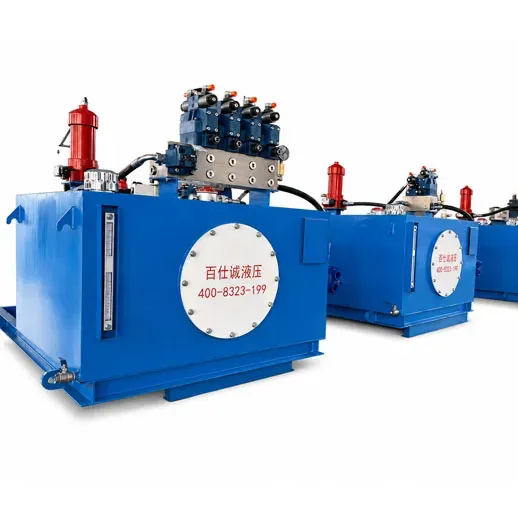
Custom vs. Catalog Hydraulic Power Units: Where the Real Differences Show Up
The two approaches diverge on more than price. Here’s where the practical differences actually land:
| Dimension |
Catalog / Off-the-Shelf Power Unit |
Custom-Engineered System |
| Design starting point |
Fixed pump/motor/tank combination pre-selected by the manufacturer |
Pressure, flow, and control logic derived from the target machine’s duty cycle |
| Control integration |
Standard manual or basic electric controls; PLC integration is retrofitted after purchase |
PLC panel, servo-hydraulic, or VFD integration engineered as part of the original design |
| Mounting & footprint |
Sized to a standard enclosure; the machine layout has to adapt to the unit |
Manifold, tank, and valve layout built to fit the available installation space |
| Multi-function circuits |
Usually single-function — one cylinder or one motor per unit |
Can combine several functions in one circuit, such as clamping, lifting, and positioning together |
| Pre-shipment testing |
Varies by supplier; full-load testing isn’t guaranteed |
Full operating-pressure and full-flow testing before dispatch, with factory witness testing available |
| Best fit |
Standard machinery with conventional pressure/flow needs |
Non-standard, heavy-duty, or extreme-condition equipment |
If your application fits the left column, a catalog unit is usually faster and cheaper to source. Nothing here changes that calculation for straightforward jobs — this guide is for the applications that don’t fit it.
Seven Parameters to Define Before You Request a Quote
Whatever supplier you’re evaluating, the accuracy of any quote depends on how well you’ve defined the following before the conversation starts:
- Operating pressure, including spikes. Don’t just state the nominal working pressure — note any pressure spikes or shock loads the circuit will see during startup, direction changes, or emergency stops.
- Flow rate and cycle time. How fast does the cylinder or motor need to move, and how many cycles per hour or per shift?
- Load, force, and duty cycle. Continuous duty and intermittent duty call for different pump sizing and thermal management.
- Motion profile. Linear, rotary, or multi-axis motion changes the cylinder and valve architecture from the ground up.
- Control logic and interface. Manual, standalone electric, or integration with an existing PLC/servo-hydraulic system — this decides whether the hydraulic engineer needs to coordinate with your automation team.
- Installation footprint and mounting constraints. Tank size, manifold placement, and access for maintenance all depend on the physical space you’re working with.
- Environmental conditions. Ambient temperature, contamination exposure, washdown requirements, or hazardous-area classification all affect seal materials, filtration, and enclosure design.
Bring these seven to the first conversation and you’ll get a quote that reflects your actual machine — not a generic estimate that gets revised twice before it’s usable.
Where Baishicheng’s Custom Systems Are Actually Deployed
Baishicheng, founded in 1995 with more than 30 years in hydraulic engineering and manufacturing, publishes custom industrial hydraulic system configurations across a specific set of applications rather than a generic catalog line: forging press hydraulic systems, an integrated hydraulic system for an IBC tank production line, an aircraft engine test hydraulic system, hydraulic systems for mining electric vehicles, chain riveting equipment, graphite electrode internal string furnace systems, copper tube riveting equipment, metallurgical equipment, and CNC machine tool hydraulics.
No single published pressure, flow, tank-capacity, or motor-power range covers all of these, because each one is engineered to the customer’s own operating conditions. What the company does disclose is an engineering capability reaching up to 120 MPa for designated ultra-high-pressure applications — a ceiling for specific engineered systems and cylinders, not a standard rating you should expect on every product line (more on that distinction below).
From Requirements Review to Pre-Shipment Testing: How a Custom System Gets Built
The manufacturing process behind a custom hydraulic system is where the engineering commitment either holds up or doesn’t. Baishicheng’s published capability covers:
- Requirements analysis and engineering design against the parameters above.
- Hydraulic manifold machining and cylinder honing to the specified tolerances.
- System assembly and PLC panel integration where the project calls for automation.
- Full operating-pressure and full-flow testing — not a spot check, but a test run at the actual conditions the system will see in service.
- Pre-shipment commissioning, with factory witness testing available if you want your own engineer present for the final test.
That last option is worth asking about directly. A supplier willing to let you watch the full-pressure test before the unit leaves the factory is telling you something different than one who just sends a test certificate after the fact.
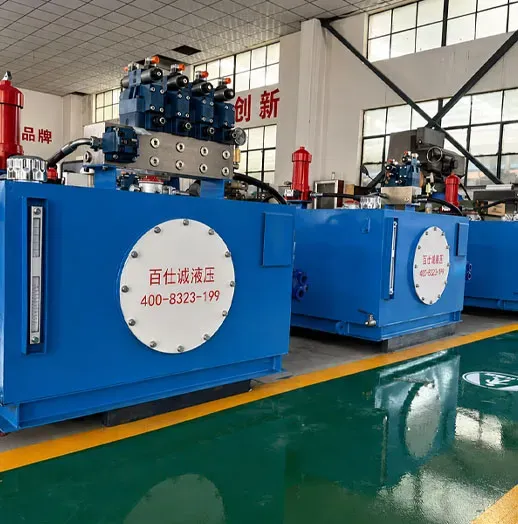
The Mistake That Turns a Custom Project Into a Rework Project
The single most common way a custom hydraulic project goes wrong isn’t a bad component — it’s an incomplete pressure spec. Buyers often quote a nominal working pressure and stop there, without flagging the pressure spikes that occur during rapid direction changes or emergency stops. The manifold, relief valve, and seal selection all get sized to the number you gave, so if that number was the average and not the peak, you find out during commissioning, not during design review.
A second, related mistake is assuming a supplier’s headline capability applies across their whole catalog. Baishicheng’s 120 MPa ultra-high-pressure figure describes what its engineering team can design and manufacture for specific ultra-high-pressure systems and cylinders — it isn’t the working pressure of a standard forging-press or CNC-tool hydraulic system. Treating a maximum capability as a baseline spec is a fast way to over-order pressure rating you don’t need, or worse, under-order it on a different line by assuming “they can do 120 MPa” covers everything they build.
Pricing: Why There’s No Published Price List
Baishicheng doesn’t publish a price list or a per-model price range for custom hydraulic systems, and that’s structural rather than evasive: pressure, flow, load, stroke, control complexity, and installation requirements vary by project, so the cost driver isn’t a fixed model number. Expect any legitimate custom-hydraulics quote — from Baishicheng or any other engineering-led supplier — to start with the seven parameters above, not a price sheet. If a supplier gives you a firm number before asking about your duty cycle and control interface, that’s worth a second look.
FAQ
Q: What makes a hydraulic system “custom” instead of off-the-shelf?
A: A custom system is designed from your machine’s actual pressure, flow, load, and control requirements, rather than selected from a fixed catalog configuration you adapt around.
Q: What information should I have ready before requesting a quote?
A: The seven parameters covered above — operating pressure including spikes, flow rate/cycle time, load and duty cycle, motion profile, control logic, installation footprint, and environmental conditions.
Q: Can I have my own engineer present for testing before the system ships?
A: Baishicheng states that factory witness testing is available alongside its standard full-pressure and full-flow pre-shipment testing.
Q: Is Baishicheng currently ISO 9001 certified?
A: The company’s published certificate covers the 2022–2025 period. Request a current certificate directly to confirm 2026 status before citing it in a procurement file.
Q: What’s the highest pressure a custom system can be engineered for?
A: Baishicheng states an engineering capability up to 120 MPa for designated ultra-high-pressure systems and cylinders — this applies to specific engineered products, not as the standard rating across every product line.
Q: How is pricing determined?
A: Project by project, based on your operating pressure, flow, load, control complexity, and installation requirements. No standard price list is published.
About the Author
This guide was produced by the Baishicheng Hydraulic Engineering Team, which supports the design, manufacture, testing, and commissioning of custom hydraulic systems, hydraulic power units, hydraulic cylinders, and automation-integrated industrial equipment. The team’s engineering scope covers hydraulics, pneumatics, PLC automation, servo drives, variable-frequency drives, and mechanical integration. Baishicheng Hydraulic was founded in 1995 and has more than 30 years of company-level hydraulic engineering and manufacturing experience — presented here as company and team experience, not the personal history of an individual author.

 English
  Get a Quote


 August 22, 2026