Baishicheng Hydraulic Engineering Team | Technical Content Contributor | Published August 2026
Capacity band alone won’t tell you which pelletizer fits your operation. Match the machine to your feed pattern, blasting demand, and floor space — not the largest throughput figure on a comparison chart.
Why Capacity Bands on Spec Sheets Don’t Answer the Real Question
Search any industrial marketplace for dry ice pelletizers and you’ll find dozens of listings sorted by output capacity. What those listings rarely explain is how a buyer is supposed to translate their own operation — a certain number of blasting cabinets, a certain shift pattern, a certain amount of floor space next to a production line — into a capacity number in the first place.
That gap matters more than it looks. A pelletizer sized for a workload it never actually sees sits idle most of the day, ties up capital, and still needs the same maintenance attention as a fully utilized unit. One sized too small can’t keep pace during peak demand, forcing a second purchase within a year or two.
What “Capacity” Actually Describes
Before comparing machines, it helps to separate three things vendors often blur together on a single spec line:
- Peak instantaneous output — the maximum rate the extrusion mechanism can sustain for short bursts.
- Sustained operating output — what the machine can realistically produce across a full shift, accounting for CO2 supply, hydraulic cycle time, and operator loading.
- Effective usable output — sustained output minus downtime for pellet collection, hopper refill, and routine cleaning.
Most buyer confusion traces back to comparing a competitor’s peak figure against a different competitor’s sustained figure, then wondering why real-world results don’t match the brochure.
Matching a Machine to Your Operating Profile
Rather than starting from a kilogram-per-hour figure you can’t yet verify, start from how the machine will actually be used. The table below groups buyers by operating pattern — the dimension that determines which machine class fits, independent of any single vendor’s exact numbers.
| Operating Profile |
Typical Use Case |
Feed Pattern |
Control Priority |
Footprint Priority |
| Intermittent / small-batch |
Occasional blast cleaning, single cabinet, lab or workshop use |
Manual, on-demand loading |
Basic on/off operation acceptable |
Low — space rarely a constraint |
| Regular multi-shift |
Scheduled blasting across 2–3 shifts, dedicated dry ice storage |
Semi-automated feed, predictable timing |
Repeatable settings, minimal operator variance |
Moderate — fits into an existing utility room |
| Continuous / high-frequency |
Multiple simultaneous blasting stations or a production line feeding into packaging |
Continuous or near-continuous feed |
PLC-level control, touchscreen recall of settings |
High — compact vertical footprint matters most |
If you don’t yet know which row you fall into, count how many blasting operations or downstream processes will draw from the machine simultaneously, then estimate hours of continuous run time per shift. That single exercise resolves most of the sizing question before a single spec number enters the conversation.
The Sizing Mistake Worth Naming
The most common error isn’t picking a machine that’s too small — it’s the opposite. Buyers frequently size for a theoretical worst-case demand day that occurs a handful of times a year, then run an oversized machine at a fraction of its rated output for the remaining months. That approach isn’t wrong for every operation — a facility with genuinely unpredictable, spiky demand may need the headroom — but for steady, plannable operations it usually means paying for capacity, floor space, and maintenance overhead that never gets used. Sizing to your sustained operating output, with a modest margin rather than a peak-day margin, tends to match actual usage more closely for most buyers.
Where Compact, PLC-Controlled Extrusion Fits
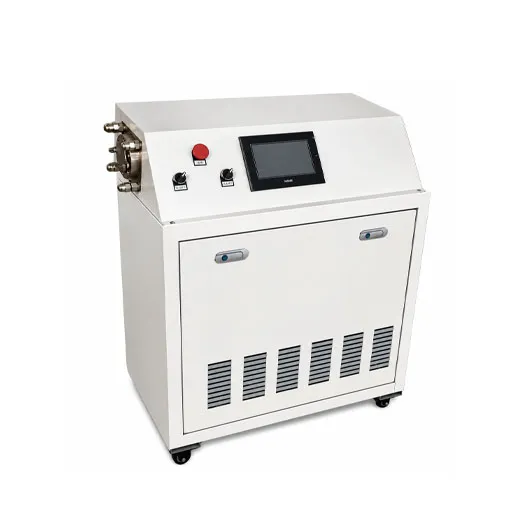
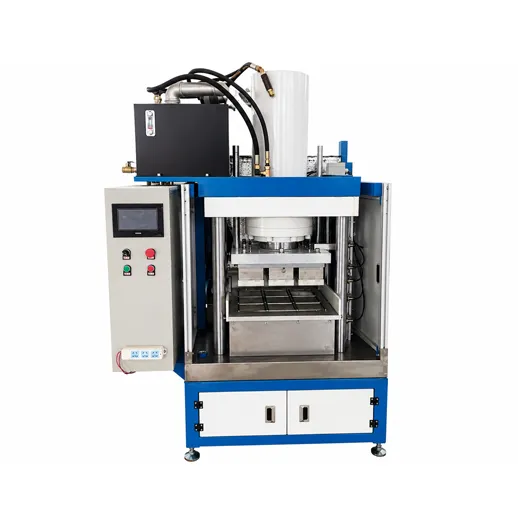
Baishicheng’s Compact Dry Ice Pelletizer is built around a vertical cabinet architecture, hydraulic extrusion, and PLC control with touchscreen operation. That combination targets the continuous / high-frequency profile described above: facilities where floor space next to a production line is limited, where operators need repeatable settings rather than manual adjustment, and where noise and maintenance access affect where the unit can physically sit. The company’s published case for this product line describes it as addressing limited installation space, complex manual operation, and unstable extrusion performance — concerns that surface specifically in continuous-use settings rather than occasional-use ones.
Compared with the fixed-capacity, manually operated units that make up a large share of listings on industrial marketplaces, a touchscreen-controlled unit trades some of that manual flexibility for repeatability — settings can be recalled rather than re-tuned by feel each shift, which matters more as usage frequency increases and matters less for a single-cabinet, occasional-use operation.
Baishicheng’s Qingdao manufacturing facility operates under a quality-management system certified to GB/T 19001-2016 / ISO 9001:2015 for the 2022–2025 certification period, covering system assembly and testing processes across its hydraulic product lines, including PLC panel integration.
Trade-Offs to Weigh Before Buying
Hydraulic extrusion pelletizers aren’t the right fit for every operation. Weigh both sides before specifying one:
Advantages:
- Compact vertical footprint suits facilities where floor space near the production line is limited.
- PLC and touchscreen control reduce operator-to-operator variation in pellet output.
- Hydraulic extrusion is suited to continuous or near-continuous feed patterns without manual re-tuning.
Trade-offs:
- A PLC-controlled unit adds electrical and control-system complexity that a purely mechanical, manually operated pelletizer doesn’t have — that means a different maintenance skill set on-site, not just a different machine.
- For genuinely occasional, single-cabinet use, the automation and compact-footprint advantages largely go unused, and a simpler manual unit may be the more cost-effective fit.
- Exact throughput, motor power, and dimensional specifications for this product line are provided on a project-specific basis rather than published as a fixed catalogue figure, so buyers comparing against listed spec-sheet numbers elsewhere will need to request the equivalent figures directly.
Pricing
Because pelletizer configuration depends on operating pressure, feed requirements, control specification, and installation conditions, pricing for this product line is quoted per project rather than published as a fixed list price. If you’re comparing against a listed price elsewhere, request a like-for-like quote based on your operating profile rather than the base unit price alone.
FAQ
Q: What’s the difference between peak output and sustained output on a pelletizer spec sheet?
A: Peak output is the maximum short-burst rate; sustained output is what the machine produces reliably across a full working shift once hopper refills, cleaning, and cycle time are factored in. Sizing decisions should generally be based on sustained output, not peak.
Q: How do I know if I need PLC/touchscreen control versus a simpler manual unit?
A: If the machine will run continuously or near-continuously across multiple shifts or feed several blasting stations at once, repeatable PLC-recalled settings reduce operator variance. For occasional, single-cabinet use, manual control is often sufficient.
Q: Does a bigger capacity rating always mean better value?
A: Not necessarily. A unit rated well above your sustained operating need adds unused capital cost and floor space without a corresponding operational benefit — sizing to your actual usage pattern, with a modest margin, is usually the more cost-effective approach.
If your operation runs closer to the continuous end of the spectrum, the next step is mapping your actual shift-by-shift CO2 and blasting demand before requesting a project-specific configuration.

 English
  Get a Quote


 August 28, 2026