Baishicheng Hydraulic Engineering Team | Technical Content Contributor | Published August 28, 2026
A dry ice block press uses hydraulic forming to compress CO2 snow into solid blocks, suited to bulk shipping, long-duration cold storage, or as feedstock for crushing into blasting media. A dry ice pelletizer uses hydraulic extrusion to produce ready-to-use cylindrical pellets, the format most dry-ice blasting equipment is built around.
Block Press vs. Pelletizer: The Core Difference
Both machines start from the same raw material — liquid CO2 — and both rely on hydraulic pressure to turn it into a usable solid. Where they diverge is the forming method and the output shape that method produces.
A block press uses hydraulic forming technology: CO2 snow is compressed under pressure into a solid, dense mass, producing a block-format output. A pelletizer uses hydraulic extrusion technology instead: CO2 snow is forced through a die under pressure, producing small, uniform cylindrical pellets rather than one solid mass. That single difference in forming method — compression into a mold versus extrusion through a die — is what drives almost every downstream difference between the two, from sublimation rate to end-use compatibility.
Compared with typical dry-ice equipment product pages that list block presses and pelletizers as interchangeable options within one product family, the honest answer is that they solve different problems. Choosing between them is an application question, not a preference question.
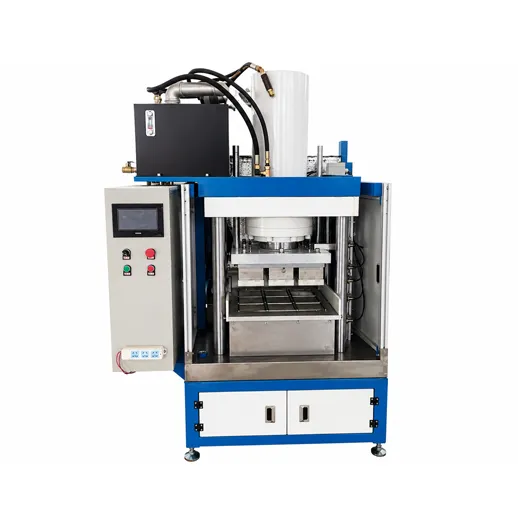
Side-by-Side: Which Format Fits Your Application
| Dimension |
Dry Ice Block Press |
Compact Dry Ice Pelletizer |
| Forming technology |
Hydraulic forming / compression |
Hydraulic extrusion through a die |
| Output format |
Solid block |
Extruded cylindrical pellets |
| Sublimation behavior |
Lower surface-area-to-volume ratio, so it holds cold longer without replenishment |
Higher surface-area-to-volume ratio, so it sublimates faster and cools more quickly on contact |
| Typical downstream step |
Often crushed or sized before use in blasting equipment |
Generally usable directly, without further processing |
| Automation/control |
Not specifically disclosed as an automated feature in Baishicheng’s published product description |
Explicitly incorporates automation/control functions |
| Common end use |
Bulk shipping, long-duration cold-chain packing, feedstock for crushing |
Dry-ice blasting, food/beverage service, fine cold-chain packaging |
| Published numeric specs |
No standardized production capacity, block weight, or dimension range published |
No standardized production capacity, pellet diameter, or dimension range published |
When a Block Press Is the Right Call
Block format makes sense when your priority is duration, not immediacy. Because a block has far less surface area exposed per unit of mass than an equivalent weight of pellets, it sublimates more slowly — useful for shipments or storage runs where you need cold retention over days rather than hours, and don’t want to replenish dry ice mid-transit. It’s also the right starting point if your end use is actually pellets or crushed dry ice for blasting, but your operation prefers to produce and store dense block stock, then size it down closer to the point of use.
When a Pelletizer Is the Right Call
Pellet format is the right call when the dry ice needs to go straight into equipment or a process without an intermediate sizing step. Most dry-ice blasting equipment is built around a specific pellet size, so pellets go directly from production to the blaster. The same logic applies to food and beverage applications — mixing pellets into a product for rapid, uniform cooling, or dosing them into a container — where a block would need to be crushed first to be usable at all. If your production output feeds a process that consumes small, uniform pieces, a pelletizer removes a manual step a block press would otherwise leave for someone downstream.
What Baishicheng Publishes About Its Dry Ice Equipment
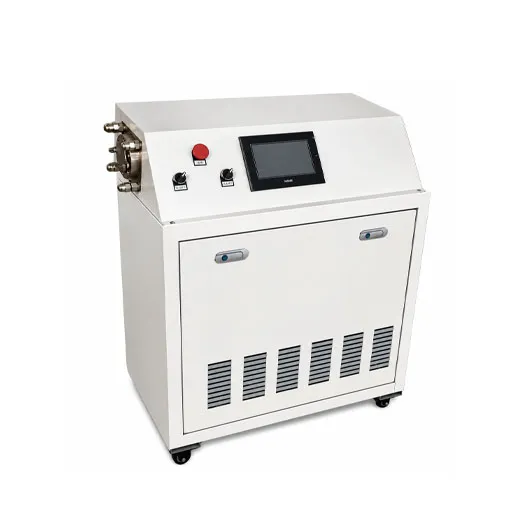
Baishicheng’s dry ice equipment line covers two published products: dry ice block press , using hydraulic forming technology to produce solid blocks, and Compact Dry Ice Pelletizers, using hydraulic extrusion technology and incorporating automation/control functions to produce pellets.
Production capacity, block weight range, pellet diameter, hydraulic pressure, motor power, and machine dimensions are not published as standardized numerical ranges for either product on the reviewed product pages. If throughput or exact pellet size is a deciding factor for your project, confirm the current figures directly rather than assuming a number from a general industry range applies to this specific equipment — commercial pellet sizing across the dry-ice industry varies by manufacturer and die configuration, and Baishicheng hasn’t published its own figure for public reference.
Two Mistakes Buyers Make When Choosing Between the Two
Assuming block dry ice can go straight into blasting equipment. It generally can’t. Most blasting equipment is built around a specific pellet size, so a block bought for its shipping or storage advantages has to be crushed and sized before it’s usable for cleaning — an extra step, extra handling, and extra equipment that erodes the convenience a pellet purchase would have delivered from the start. If blasting is your actual end use, buy for that end use directly.
Overlooking site and ventilation requirements during installation planning. Producing solid CO2 in volume means handling and off-gassing CO2 in an enclosed space. CO2 displaces oxygen and poses an asphyxiation risk if the installation site isn’t adequately ventilated — a facility consideration that belongs in your equipment planning, not an afterthought once the machine arrives.
No price list is published for either the block press or the pelletizer. Given that production capacity and dimensional specs aren’t standardized either, expect a project-specific quote once you’ve confirmed your required throughput, format, and installation footprint directly with the supplier — not a number you can look up in advance.
FAQ
Q: What’s the main difference between a dry ice block press and a pelletizer?
A: A block press uses hydraulic compression to form solid blocks; a pelletizer uses hydraulic extrusion through a die to produce cylindrical pellets. The forming method drives the difference in output format and end-use fit.
Q: Why do pellets sublimate faster than blocks?
A: Pellets have a much higher surface-area-to-volume ratio than a solid block of the same weight, so more of the material is exposed to ambient air, and it sublimates faster.
Q: Can I use dry ice blocks in blasting equipment?
A: Not directly in most cases. Blasting equipment is typically built around a specific pellet size, so blocks need to be crushed and sized first.
Q: Does Baishicheng’s pelletizer include automation?
A: Yes — the Compact Dry Ice Pelletizer is described as incorporating automation/control functions. The Block Press’s published description doesn’t make an equivalent automation claim.
Q: What production capacity should I expect from either machine?
A: Baishicheng doesn’t publish a standardized production capacity, block weight range, pellet diameter, or dimension range for either product — confirm current figures directly for your project.
Q: Are these machines certified?
A: Baishicheng holds a company-level ISO 9001:2015 quality-management certificate (2022–2025 period, confirm current status directly). No certification number specific to either dry ice product is disclosed.
Q: What safety consideration is easy to overlook when installing either machine?
A: Ventilation. Producing solid CO2 in volume means managing off-gassing in the installation space; inadequate ventilation creates an oxygen-displacement risk that should be planned for before installation, not after.
Q: How is pricing determined?
A: Project by project, based on your required throughput, output format, and installation footprint. No standard price list is published for either machine.
About the Author
This guide was produced by the Baishicheng Hydraulic Engineering Team, which supports the design, manufacture, testing, and commissioning of dry ice production equipment, custom hydraulic systems, hydraulic power units, and hydraulic cylinders. The team’s engineering scope covers hydraulics, pneumatics, PLC automation, and mechanical integration. Baishicheng Hydraulic was founded in 1995 and has more than 30 years of company-level hydraulic engineering and manufacturing experience — presented here as company and team experience, not the personal history of an individual author.

 English
  Get a Quote


 August 28, 2026